

Are You Adhering to Codes? What Facility Managers Need to Know About Requirements for Hydrogen Detection Systems
Picture this scenario: A forklift operator flicks a cigarette onto a charging battery, with the resulting explosion as loud as a cannon. This isn’t a cautionary tale from a safety training video—it’s a real incident witnessed by H2scan personnel in an active warehouse facility. The operator survived, but the message is clear: hydrogen accumulation in forklift charging areas isn’t a theoretical risk. It’s a present danger that many facilities could use greater assistance to properly manage.
Hydrogen’s properties create unique detection challenges. The gas is colorless and odorless, providing no sensory warning before reaching its lower flammability limit (LFL) of 4% by volume in air. Facilities relying solely on ventilation systems operate without confirmation that hydrogen levels remain within safe limits.
Understanding the Regulatory Landscape of Hydrogen Gas Detection
Electric forklifts now represent approximately 72% of the material handling equipment market, with roughly 75% of these units powered by lead-acid batteries that produce hydrogen during charging. This widespread adoption of battery-powered equipment has made hydrogen gas detection management a common regulatory concern across warehouses, distribution centers and manufacturing facilities.
Fire codes address hydrogen risks through specific requirements for areas where batteries are charged and stored. The International Fire Code (IFC), NFPA 855 fire code (Standard for the Installation of Stationary Energy Storage Systems) has gained international adoption, establishing concentration thresholds and monitoring requirements. OSHA 29 CFR 1910.178 (g) specifically addresses powered industrial trucks pertaining to ventilation, and similarly 29 CFR 1926.441 (a) addresses Batteries and battery charging to prevent accumulation of explosive gas. IEC 62485-2 and relevant IEEE standards provide additional guidance for energy storage applications.
| Standard/Code | Role in Forklift Charging Area Safety | Hydrogen Relevance |
|---|---|---|
| NFPA 1, NFPA 855 & IFC | Mandated Safety Limit | Sets the legally binding 1.0% H2 concentration limit and often the minimum floor-area ventilation rate (CFM/ft2). |
| OSHA 1910.178 (g) | Worker Safety/Environment | Requires designated, well-ventilated areas, and prohibits ignition sources (sparks, open flames) in the charging area. |
| IEEE Std 484/1635 | Engineering Calculation Methodology | Provides the detailed, precise formulas for calculating the exact volume of air (CFM or m3/h) needed to dilute the hydrogen based on battery type, number of cells, and charging current. |
| IEC 62485-2 | International Engineering Basis | Provides an international standard and calculation methodology (often used in metric units m3/h) for safe battery room ventilation. |
| OSHA 1910.178 (g) | Worker Safety/Environment | Requires designated, well-ventilated areas, and prohibits ignition sources (sparks, open flames) in the charging area. |
| IEEE Std 484/1635 | Engineering Calculation Methodology | Provides the detailed, precise formulas for calculating the exact volume of air (CFM or m3/h) needed to dilute the hydrogen based on battery type, number of cells, and charging current. |
| IEC 62485-2 | International Engineering Basis | Provides an international standard and calculation methodology (often used in metric units m3/h) for safe battery room ventilation. |
Code compliance presents challenges beyond meeting baseline requirements. Local authorities having jurisdiction maintain discretion to impose standards exceeding national codes based on site-specific risk assessments. A charging area compliant with NFPA standards may require additional safeguards if local inspectors determine conditions warrant enhanced protection.

A government facility in Los Angeles County encountered this scenario. Despite designing the charging area to code specifications, the local fire marshal classified the space as too confined for the battery charging volume. The facility received a mandate to install hydrogen gas detection with alarm thresholds even below standard code requirements—demonstrating how authorities can require protective measures beyond baseline standards when site conditions raise concerns.
When Compliance Becomes Non-Compliance
Facilities may lose compliance status through operational changes that compromise original system designs:
- Fleet expansion: Additional forklifts increase simultaneous battery charging without corresponding ventilation upgrades
- Mechanical degradation: Exhaust systems develop reduced capacity through component failures
- Operational modifications: Fast charging protocols generate higher hydrogen concentrations than standard charging cycles
- Maintenance requirements: Requires batteries to be equalize charged (controlled overcharge) to remove sulfate buildup on plates and balance the cell voltages.
- Structural changes: Building renovations alter engineered air flow patterns
These changes occur without warning indicators. Fire inspectors conduct regular facility reviews specifically because compliance status can deteriorate between inspections as operational conditions evolve.
Fire Inspector Evaluation Criteria for Hydrogen Detection Systems
Inspectors assess charging areas through quantitative and qualitative methods. Evaluations include space volume calculations in relation to battery charging capacity, redundancy, verification of the ventilation system and inspection for hydrogen-related damage indicators, such as scorching or corrosion patterns on electrical connections.
A critical evaluation component involves determining whether facilities possess verification systems for hydrogen concentrations. Ventilation systems may satisfy minimum code requirements yet provide no confirmation of actual effectiveness. Equipment failures, ductwork deterioration and air flow obstructions reduce system effectiveness without obvious symptoms.
Detection systems act as verification tools, ensuring that ventilation keeps hydrogen levels below dangerous thresholds and providing early warnings of system deterioration and hydrogen buildup before levels become hazardous. In addition to assessing gas-reduction or detection systems, Hazardous Mitigation Strategies must be maintained to detect and respond to mechanical failures or elevated hydrogen levels.
Confined Space Classification
Charging areas meeting confined space criteria face substantially increased regulatory requirements. Confined space designation applies to areas large enough for worker entry but having limited access points and lacking continuous occupancy design. Classification triggers requirements for comprehensive monitoring, formal entry procedures, specialized personnel training and extensive documentation protocols.
Inspectors maintain authority to classify spaces as non-compliant regardless of original design intent. The Los Angeles County case demonstrates this discretion—inspectors determined that battery charging volume created confined space conditions requiring enhanced safety measures.
Cost Comparison: Hydrogen Gas Detection vs. Ventilation Upgrades
Hydrogen detection systems require lower capital investment than ventilation system modifications. Ventilation capacity increases necessitate engineering analysis, ductwork installation or modification, additional exhaust equipment, electrical infrastructure upgrades and potential structural modifications. These projects typically reach tens of thousands of dollars before addressing ongoing operational costs. And you still need sensors to determine if the ventilation is working to reduce the potential for hydrogen buildup.
Overventilation incurs continuous operational expenses due to increased electrical consumption and higher heating/cooling loads resulting from greater air exchange volumes. Hydrogen detection systems eliminate these recurring costs while having the ability to trigger an alarm when hazardous levels of hydrogen are present and also provide real-time data to assess hydrogen levels within the battery charging area.
While there is no official standard for the number of sensors in a given space, a typical forklift charging area coverage will have one sensor per 50 feet of open space, with additional units in areas where hydrogen may accumulate. These areas are usually near the ceiling and close to the charging area within the path of rising hydrogen gas. The installation integrates with the existing electrical infrastructure, and ongoing maintenance primarily consists of annual calibration.
System Integration
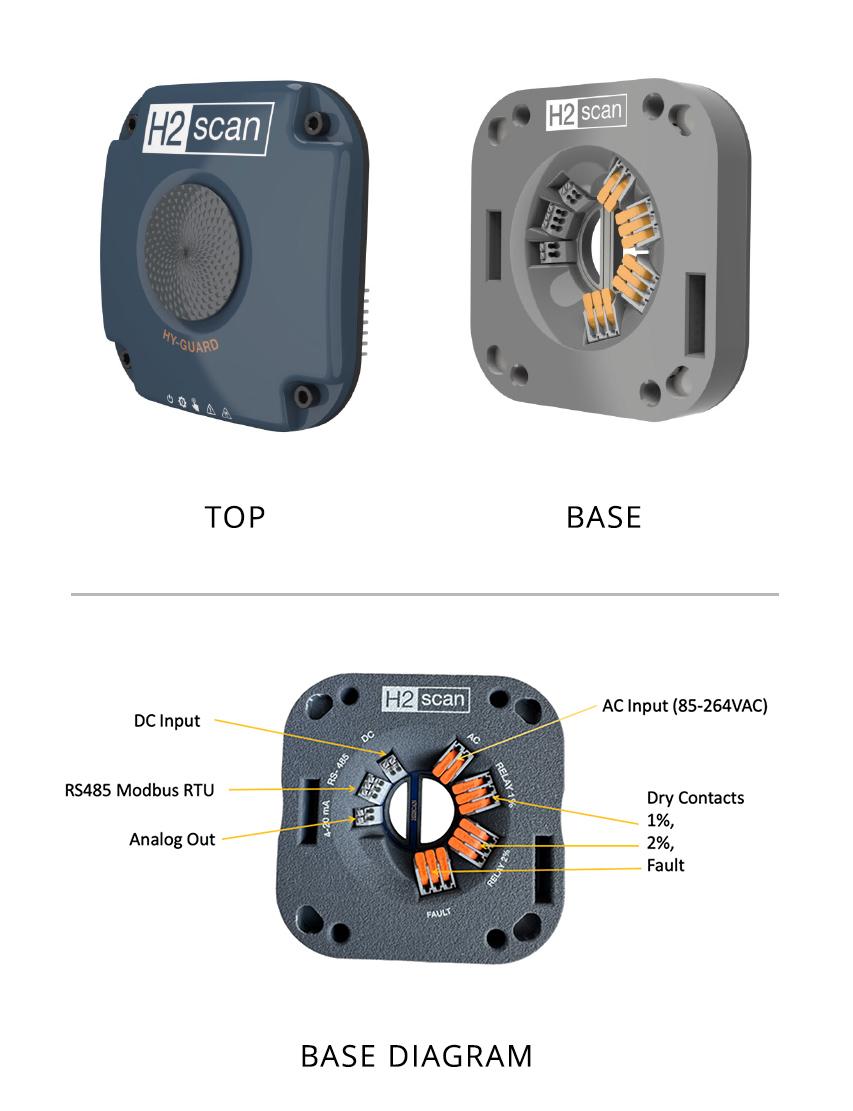
Contemporary hydrogen detection systems are designed to accommodate existing facility infrastructure. Facilities with building management systems integrate detection through standard relay contacts, enabling alarm routing to central monitoring and mobile notifications. Other integration options include automatic charger shutdown or automated ventilation activation when in an alarm condition.
Detection systems typically exclude direct connections to fire department systems. False alarm penalties in most jurisdictions make such connections impractical. Instead, hydrogen detection systems are designed to alert facility personnel when hydrogen levels reach as low as 1%, which is well below the lower explosive limit (LEL) of 4%, allowing investigation and remediation before conditions become dangerous and trigger an emergency response.
Proactive Implementation for Electric Forklift Charging Station Safety Requirements
Reactive compliance scenarios create operational challenges. When inspectors mandate immediate corrective action with compressed timelines, facilities lack adequate time for thorough evaluation, competitive procurement and coordinated installation scheduling.
Strategic facility management includes assessing charging areas before regulatory requirements arise. This approach involves reviewing current fire codes (see table 1) and local amendments, evaluating existing charging areas against evolving standards, and implementing detection as planned capital investment rather than emergency response.
Hydrogen detection implementation demonstrates safety program maturity that exceeds minimum compliance requirements. During incident investigations or regulatory inspections, facilities with documented monitoring programs, calibration records, and alarm response protocols and records, demonstrate systematic risk management, which regulatory agencies evaluate favorably.
When inspectors inquire about hydrogen level verification, documented monitoring provides objective evidence of ongoing compliance rather than reliance on assumed ventilation adequacy.
Regulatory trends indicate an increasing requirement for hydrogen concentration verification, rather than relying solely on theoretical ventilation adequacy. Facilities implementing monitoring ahead of mandates position themselves for streamlined inspections and reduced compliance risk.
Comprehensive Solutions
H2scan’s hydrogen detection technology addresses multiple battery applications beyond forklift charging to meet electric forklift charging station safety requirements. The company’s HY-GUARD™ product applies the same sensing technology to stationary battery installations and energy storage systems, supporting compliance with IFC, NFPA 1, NFPA 855, OSHA 1910.178 (g), IEC 62485-2 and IEEE 484 & 1635 standards across battery-related applications. Solutions are engineered for sustained accuracy and operational reliability in both forklift charging and standby power battery applications.
About the Author: Jeff Donato
