

All Forklift Operators Experience Hydrogen Accumulation—Smart Operations Have a Plan
The material handling industry accounts for approximately 72% of all forklifts in operation worldwide. This shift toward battery-powered equipment reflects growing environmental concerns, stricter emissions regulations and the operational advantages of electric over internal combustion power. It’s a trend that’s accelerating—by 2030, industry analysts project electric forklift sales will reach nearly 1.5 million units annually.
The widespread adoption of electric forklifts solved one problem by eliminating diesel and propane emissions from indoor spaces. However, it created another challenge in electric forklift safety that many facilities have yet to address: the continuous production of hydrogen gas in charging areas. Roughly 75% of these electric forklifts run on rechargeable lead-acid batteries, and every single one of them produces hydrogen gas during charging.
The question is not whether you have hydrogen in your facility. The question is whether you have the right “early-warning” hydrogen monitoring systems in place to responsibly protect your people and facility.
Hydrogen accumulation is a silent but serious risk in battery charging environments.
Without proper ventilation or detection, hydrogen released during forklift battery charging can rise unnoticed and reach explosive concentrations near the ceiling. The consequences can be severe:
- Explosion or fire when ignition sources (e.g., switches, relays, static discharge) are present.
- Facility damage and potential loss of life in confined battery charging rooms.
- Insurance and code compliance violations, including IFC, NFPA 1, NFPA 855, OSHA 1910.178 (g), IEC 62485-2 and IEEE 484 & 1635 standards
- Operational downtime and reputational harm following a preventable incident.
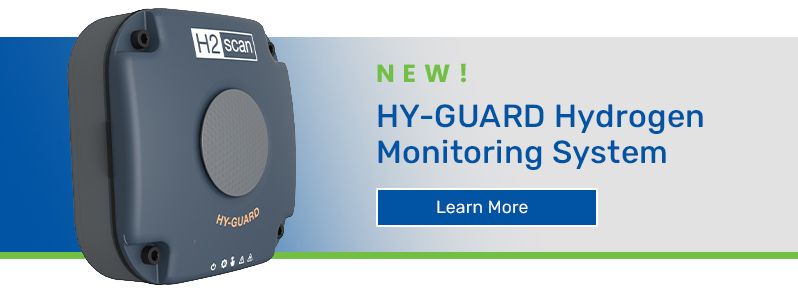
The good news: preventing these hazards is straightforward. A continuous, fixed-area hydrogen detection system, such as the HY-GUARD Hydrogen Area Monitor can provide early warning and activation of safety systems before conditions become dangerous—helping operations teams maintain compliance, protect personnel, and ensure business continuity.
Understanding the Charging Environment and Electric Forklift Safety
Forklift battery charging occurs in two primary ways, both of which produce hydrogen gas. The most common setup involves backing forklifts into charging stations where they remain plugged in until the battery reaches full capacity. The alternative is a battery swap system, where depleted batteries are removed and replaced with fully charged ones using specialized equipment.
- Fast charging – Operations that require fast charging present a particular challenge. Some facilities operate around the clock and need their equipment available with minimal downtime. Fast charging delivers that availability, but it also produces significantly more hydrogen gas than standard charging cycles. The aggressive charging process generates more heat, consumes more water from the battery cells, and releases more hydrogen into the charging area.
- Battery swap systems – These offer advantages beyond operational efficiency. These systems are gentler on the batteries themselves, extending battery life and reducing the rate of hydrogen production. However, they require more upfront investment in equipment and additional battery inventory. Regardless of which system a facility uses, hydrogen gassing remains a constant factor that demands attention.
When Hydrogen Becomes Hydrogen Sulfide
Hydrogen accumulation isn’t the only concern in electric forklift battery safety. Batteries are commonly overcharged, and, in this instance, the chemistry changes. Hydrogen can bind with sulfur molecules from the battery’s lead-acid composition, creating hydrogen sulfide, a toxic gas that has a distinctive rotten egg smell.
Unlike hydrogen, which is lighter than air and rises, hydrogen sulfide is heavier and settles at ground level, where workers breathe. Even brief exposure to hydrogen sulfide causes throat irritation and respiratory discomfort. Longer exposure can lead to serious health consequences. This smell has become so common in some facilities that workers accept it as normal. However, exposure to hydrogen sulfide is never acceptable, and its presence indicates a failure in either charging protocols or ventilation systems or both.
The Awareness Gap in Electric Forklift Safety
Many facilities operate under the assumption that their hydrogen monitoring and ventilation systems remain adequate over time. However, several factors can compromise what were initially sound designs:
- Fleet expansion increases the number of batteries charging simultaneously without corresponding ventilation upgrades.
- Maintenance requirements that require batteries to be equalize charged (controlled overcharge) to remove sulfate buildup on plates and balance the cell voltages.
- Mechanical failures in exhaust systems reduce air exchange rates.
- Building renovations alter airflow patterns originally engineered for hydrogen dispersion.
- The shift to fast charging protocols produces higher hydrogen concentrations than standard charging cycles.
Forward-thinking facilities implement hydrogen detection as part of their comprehensive safety program rather than waiting for a fire inspector to mandate it. Continuous monitoring provides 24/7 awareness of hydrogen levels in charging areas that may be unstaffed overnight or during shift changes, and has the ability to connect to building management systems to warn facility managers before concentrations reach concerning levels. Other integration options include automatic charger shutdown or automated ventilation activation when in an alarm condition.
Modern hydrogen detection systems can be designed specifically for electric forklift safety in charging environments and scale to facility size—a small retail operation with three forklifts needs the same protection as a major distribution center, but with fewer hydrogen sensors. A typical forklift charging area coverage will have one sensor per 50 feet of open space, with additional units in areas where hydrogen may accumulate.
Hydrogen detection also proves more cost-effective than alternative compliance approaches. Upgrading ventilation systems requires an engineering analysis, construction work, additional electrical infrastructure, and ongoing energy costs associated with increased fan operation. Detection systems provide equivalent safety assurance at much lower capital and operational costs.
Electric Forklift Safety: The Path Forward
Recognizing that hydrogen production is an inherent byproduct of lead-acid battery charging and that ventilation alone cannot ensure safety and reliability, operations managers need to evaluate available monitoring systems to secure the safety of their facility.
As an initial step, evaluate current charging areas including factors such as fleet size, charging frequency, ventilation capacity and whether operations occur during staffed or unstaffed hours. Detection systems then provide continuous verification that hydrogen concentrations remain within safe limits, offering both compliance documentation and early warning of ventilation failures or changing operational conditions.
Modern detection technology eliminates the uncertainty inherent in ventilation-only approaches. Rather than assuming adequate air exchange, facilities gain measurable data on actual hydrogen levels, which should be a vital part of the facility’s Hazardous Mitigation Plan. This information proves valuable during safety audits, insurance reviews, and operational planning.
Beyond Forklift Applications
While forklift charging represents one of the most common hydrogen detection needs in industrial facilities, H2scan’s expertise extends across multiple battery applications. The company’s HY-GUARD™ Hydrogen Area Monitor brings the same proven hydrogen sensing technology to stationary battery systems, energy storage installations and battery cabinets. Whether monitoring warehouse forklift operations or protecting critical standby power systems, H2scan offers hydrogen detection solutions designed specifically for the unique requirements of each application.
About the Author: Jeff Donato
