
Early Warning Systems: How Hydrogen Monitoring Provides Key Intelligence into Transformer Health
How much downtime can your manufacturing facility afford? Every minute wasted carries a steep price tag. Industry data shows that the average cost of unplanned downtime is $9,000 per minute, with typical outages lasting 5 to 59 minutes. For a single transformer failure, that translates into potential losses of $45,000 to $531,000 per incident—before accounting for missed deadlines, compromised product quality and dissatisfied customers.

The challenge facing manufacturing facilities has intensified dramatically in recent years. Transformer costs have surged 65% since 2020, while lead times have stretched to 60 weeks or more for smaller units. Meanwhile, modern transformers are built with increasingly tight design margins. The oil volume per MVA has decreased by 66% since 1960, resulting in reduced cooling efficiency and accelerated insulation aging. These converging pressures make proactive transformer management not just beneficial but essential for maintaining production continuity.
The Hidden Threat to Manufacturing Operations
Most transformer failures don’t happen suddenly. They begin as small, developing issues—what industry experts call “incipient faults”—that gradually worsen over weeks or months. These faults generate heat inside the transformer, which breaks down the insulating fluids and produces specific gases.
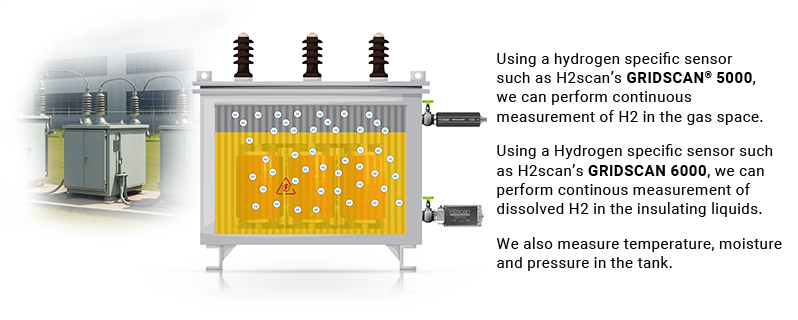
The first gas to appear in this process is hydrogen, making it an ideal early warning indicator.
When internal faults develop within a transformer, whether from insulation deterioration, overheating, partial discharge, or contamination, they generate heat. This heat breaks down the insulating fluid, producing specific gases long before visible damage occurs. Among these gases, hydrogen emerges first and continues generating across all fault temperatures—from as low as 150°C to beyond 800°C. This makes hydrogen the “key gas” for early fault detection.
The science is compelling: a six-degree winding temperature rise above 90°C can double a transformer’s aging rate. A mere 1% increase in moisture doubles the aging rate of paper insulation. These aren’t theoretical concerns—they’re accelerated degradation factors actively shortening the operational life of transformers in manufacturing facilities right now. The real advantage lies in the timeline. By continuously monitoring hydrogen levels, maintenance teams can detect developing issues weeks or even months before they progress to catastrophic failure. This advance warning provides critical time for planned intervention during scheduled maintenance windows rather than responding to emergency breakdowns that halt production.
Modern Manufacturing Creates New Stresses on Transformer Health
Today’s manufacturing environments present unique challenges for transformer health. Modern production equipment increasingly relies on variable-frequency drives, switch-mode power supplies, and other nonlinear loads that introduce harmonics into facility power systems. These harmonics create additional heating in transformers that weren’t originally designed to handle such stress.
When transformers operate at or beyond their design limits—a common scenario in energy-intensive manufacturing operations—these accelerated aging factors compound, significantly threatening power supply continuity.
Meeting the New Regulatory Reality
The regulatory environment is tightening. In 2023, the National Fire Protection Association updated NFPA 70B from a recommended practice to a mandatory standard, shifting language from “should do” to “shall do.” The updated standard now requires continuous monitoring to assess appropriate maintenance levels for transformers and electrical equipment.
Single-gas hydrogen monitoring offers a cost-effective compliance pathway. The standard explicitly permits “predictive techniques such as continuous online monitoring” to dynamically adjust maintenance intervals. By implementing hydrogen monitoring technology, facilities can simultaneously meet regulatory requirements while gaining the operational intelligence needed to optimize maintenance scheduling.
Cloud-based monitoring platforms that store historical hydrogen measurements also satisfy NFPA documentation requirements. This historical record proves invaluable during regulatory audits and demonstrates due diligence in maintenance practices—potentially reducing liability exposure if incidents occur.
Real-World Impact: Transformer Monitoring Insight
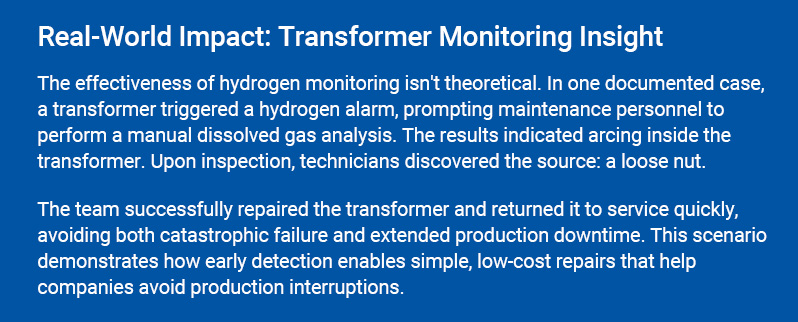
The effectiveness of hydrogen monitoring isn’t theoretical. In one documented case, a transformer triggered a hydrogen alarm, prompting maintenance personnel to perform a manual dissolved gas analysis. The results indicated arcing inside the transformer. Upon inspection, technicians discovered the source: a loose nut.
The team successfully repaired the transformer and returned it to service quickly, avoiding both catastrophic failure and extended production downtime. This scenario demonstrates how early detection enables simple, low-cost repairs that help companies avoid production interruptions.
The Path Forward for Transformer Monitoring
As manufacturing facilities navigate aging infrastructure, workforce challenges and increasingly complex electrical environments, continuous transformer monitoring transitions from a nice-to-have capability to an operational imperative. Single-gas hydrogen sensor technology provides early detection of abnormal transformer conditions while supporting broader organizational goals of reliability and efficiency.
The business case is compelling: gain insight to implement proactive maintenance action, avoid costly outages, extend transformer life, defer capital expenditures and meet evolving regulatory requirements. Organizations that implement these systems position themselves to better manage critical assets, reduce risk and optimize maintenance resources in an increasingly demanding operating environment.
Download our comprehensive white paper, “Reducing Manufacturing Downtime Through Proactive Transformer Monitoring,” to explore the science behind hydrogen monitoring, implementation considerations for manufacturing environments and detailed ROI calculations for your facility.