
Why is Hydrogen a Key Gas for Transformer Monitoring?
One of the more common questions we field is “Why is hydrogen the Key Gas for transformer monitoring? What makes it special?” The answer is both simple and complex, rooted in the behavior of insulating liquids under internal transformer fault conditions.
- Internal faults create localized heat sources in the transformer
- Heat breaks down the liquids, releasing combustible gases
- Hydrogen is the 1st fault gas produced
- Bustamante noted “Hydrogen is present in all electrical & thermal faults in oil.”
- Hydrogen will indicate the onset of insulation degradation before other fault gases are detectable
- Continuous monitoring of hydrogen becomes the missing transformer
Most transformer failures aren’t sudden. They don’t fail overnight. They fail gradually – and silently1, and there is rarely an external indication of an incipient2 fault onset, making them difficult to detect.
When faults occur in the main tank, they create localized heat sources. That heat breaks down the insulating liquid molecules, producing combustible gases, also referred to as hydrocarbons. Hydrogen is the first gas produced for nearly every transformer fault type: partial discharge, overheating, arcing, and even low-energy faults.
Its presence, therefore, indicates the beginning stages of insulation degradation, and it occurs before other fault gases become detectable. A 2019 review by Bustamante supports this, noting: “Hydrogen is present, in higher or lesser amounts, in all the electrical faults and thermal faults that occur in the oil.”
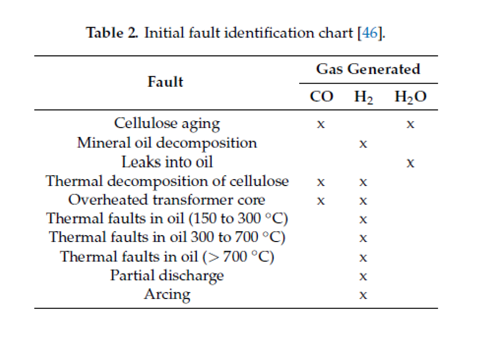
In this review, Bustamante shares a table published in the IEEE Transactions on Dielectric and Electrical Insulation magazine (Volume: 2, Issue: 6, December 2015) that identifies the gases generated at the onset of a fault.
As noted in the table, hydrogen is the key fault indicator of nearly every fault type in transformers with oil-paper insulation. It is always a by-product of insulation breakdown in electrical and thermal faults.
This makes hydrogen a reliable and broad-spectrum key fault indicator, unlike other gases that are only produced or linked to specific fault types.
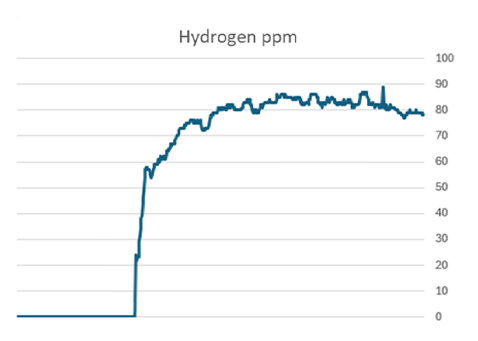
Continuous measurement of Hydrogen is therefore the missing transformer diagnostic tool, making it the key to avoiding catastrophic failures.
As can be seen in the adjacent graph, sudden or accelerated hydrogen generation precedes major transformer failures, and in this case study, the grid operator was able to avoid a catastrophic event on their 24 MVA transformer.
Continuous Hydrogen Monitoring Has Other Advantages
The benefits of hydrogen are not limited to early fault detection; it also helps identify thermal events that are frequently missed.
- It detects transformers with working but marginal cooling systems. Transformers have over-temperature protection, but sustained operation just below trip thresholds can go undetected.
- Another often-missed thermal event is high harmonic content that heats transformer cores. As renewable and ESS inverters and Variable Frequency Drives (VFD)’s proliferate, transformers in high harmonic grid sections operate hotter than intended, and without monitoring, it is difficult to identify this occurrence.
Due to its early generation during electrical degradation, high sensitivity to partial discharge and rapid detection in oil and hydrogen monitoring remains essential for identifying transformer faults before they progress to catastrophic failure.
Sources:
- Neil Probert, Johnson & Phili
- An incipient fault refers to a fault that is in its early stages, often with subtle or minor symptoms not immediately obvious. These faults worsen over time, leading to more serious issues or complete failure if not detected and addressed early.
About the Author: Traci Hopkins