
Thanks to their high power density, lithium-ion batteries are the popular choice for battery energy storage (BESS) and large-scale battery backup power (uninterruptible power supplies). Data centers and utilities depend on lithium-ion batteries to provide reliable power and meet their service obligations.
The risk is low-probability but high-consequence: lithium-ion batteries are susceptible to thermal runaway, and when it happens, it can escalate into an uncontrollable fire and lead to an explosion risk. Standards require the containers and rooms housing these batteries to be monitored for explosive hydrogen gas and to trigger ventilation equipment during a thermal event.
The hydrogen gas monitoring systems used for lithium-ion batteries must be selected carefully. Different sensor technologies have their pros and cons, and in many cases, they simply do not meet the special requirements of lithium-ion battery applications.
On paper, hydrogen sensors may look interchangeable. Every spec sheet promises detection, an alarm output and a price. But the underlying technology determines something the spec sheet doesn’t: how much the sensor will cost in maintenance, false alarms and replacement over the years it’s in service? For lithium-ion battery installations, where a slow, inaccurate or inadequately maintained sensor is a critical safety gap, that technology choice matters more than what’s on the invoice.
Four Gas Monitoring Technologies, Very Different Tradeoffs
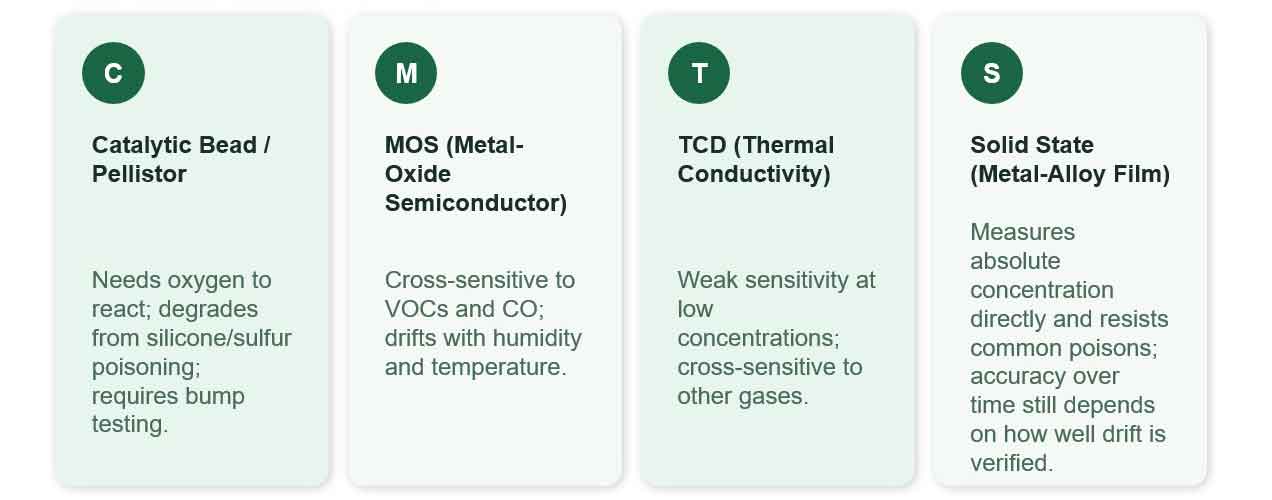
Hydrogen detection in data centers and energy storage comes down to systems using one of four sensor types.
- TCD (thermal conductivity): cross-sensitive to VOCs (volatile organic chemicals) and CO (carbon monoxide), and drifts with humidity and temperature changes.
- MOS (metal-oxide semiconductor): needs oxygen to react, degrades from silicone or sulfur poisoning, and requires regular bump testing.
- Catalytic bead (pellistor): measures absolute concentration directly and resists common poisons, but accuracy over time still depends on how well drift is verified.
- Solid-state (metal-alloy film): measures absolute concentrations and resists the poisoning and cross-sensitivity issues that affect other sensor types.
Nearly all of them, whatever the type, share one thing in common: some kind of ongoing maintenance requirement, whether that’s calibration or outright replacement.
“Self-Calibrating” and “No Calibration Required” Are Not the Same Claim
Calibration is the main factor that separates sensors. Every sensor drifts. Exposure to gas, humidity, and temperature swings gradually pulls a sensor’s reading away from true. Each sensor manufacturer follows a different method of managing this issue.
- A self-calibrating sensor continuously verifies its own accuracy: no calibration gas, no bump test, no worker entry into a hazardous area. Instead, the sensor automatically corrects its calibration on an ongoing basis.
- “No calibration required” usually means something different: the manufacturer has slowed drift and stretched the interval between required checks, sometimes to a year, sometimes longer. However, the only way to know whether the sensor has drifted out of spec between checks is to test it manually using bottled gas. This defeats the goal of a maintenance-free sensor.
For example, one catalytic sensor is marketed as maintenance-free, but its manual requires periodic bump testing. If a bump test determines that the sensor has drifted out of spec, then the technician must pull the sensor module from the unit and ship it back to the factory for recalibration.
(For a real-world case of what that maintenance requirement actually costs — and the safety liability it can create — see “Ladders, Liability and Lower Flammable Limits.”)
The Hidden Cost of a Cheap Hydrogen Sensor
Two of the most common sensors in data centers and containerized energy storage are metal-oxide units that sell in the $900 to $1,200 range and have built a large install base mostly on low price and longevity in the market. They’re also disposable: once the sensing element degrades, typically within about five years, the unit or its sensing cartridge gets swapped rather than serviced.
The bigger issue with this type of sensor isn’t lifespan; it’s specificity. Many of these general-purpose sensors respond to more than just hydrogen. Battery off-gassing during a fault produces a mixture of gasses that includes carbon monoxide alongside hydrogen. A sensor that doesn’t distinguish between the two will still trigger, without indicating whether the gas it is detecting is explosive or not. That’s a false alarm dressed up as a detection event: the sensor knows something is elevated, but not what, or how dangerous. The costs associated with a false alarm mount quickly:
- Interruption of service or production
- Facility evacuation
- Fire department visits
What’s worse, every false alarm trains people to second-guess the next one, eroding trust in the system. Customers have voiced this concern, as one complained that a prior system “cried wolf so many times that people stopped trusting it.”
Why Lithium-Ion Batteries Raise the Stakes
For lead-acid batteries, a slow or occasionally ambiguous sensor was a reasonable compromise, because lead-acid batteries gas gradually and predictably over weeks or months. Lithium-ion batteries remove that cushion. They don’t off-gas under normal operation at all, just under thermal runaway, and the window between first gas and an uncontrollable event is dangerously small. It’s worth being precise about what detection does and doesn’t do. There’s little evidence that early detection stops thermal runaway once it starts — once a battery goes into runaway, that reaction is generally going to run its course. What detection does is buy the time needed to trigger ventilation and evacuate the space before the off-gassing reaches an explosive concentration. That’s the actual job of the sensor, and it’s why speed and accuracy matter so much: not to prevent the failure, but to keep the area from becoming a bomb while it happens.
Gas monitoring systems for lithium-ion batteries need both speed and specificity. NFPA 855 and NFPA 69 require ventilation to keep concentrations below 25% LFL, which in practice demands a sensor fast and accurate enough to detect hydrogen well before that threshold.
This means that the sensor must know the concentration of hydrogen gas. Hydrogen gas measurements should not be confused with other gases, which can happen with general gas sensors. Some popular gas monitoring systems don’t report absolute concentration and instead look for a sudden increase in gas concentration. However, a relative percentage increase from a baseline is not covered by the standard.
In lithium-ion applications, a sensor needs to respond very quickly, and it needs to know that what it’s measuring is actually hydrogen, not a general spike in “some kind of gas.” A sensor that’s both slow and non-specific isn’t just underperforming; it’s providing a false sense of coverage in exactly the environment where that gap is most dangerous.
What UL 2075 Actually Requires of Battery Gas Monitoring Systems
Speed and specificity aren’t the whole story. Where NFPA 855 and NFPA 69 govern how fast a sensor must respond and at what concentration it has to act, UL 2075 governs the design, construction, and performance testing of gas and vapor detectors themselves, including how the sensor performs in adverse environments and reports faults in its own electronics. That means testing every pin on the circuit board individually and confirming the unit reports a fault correctly when something in the electronics fails.
A sensor can meet UL 2075 while still not accounting for drift if the manufacturer’s maintenance protocols are not strictly followed. The result can be a sensor that shows an “operating normally” indicator while the calibration has drifted to a point at which the sensor will not respond. It’s the “green light is on, but nobody’s home” problem. A sensor that monitors and actively self-corrects its drift avoids this problem.
Why H2scan Gas Monitoring Systems are the Right Choice for Lithium-Ion Battery Monitoring
The battery gas monitoring market has no shortage of options claiming to be maintenance-free, hydrogen-specific, or fast. Few of them are truly all three at once, and for a lithium-ion installation, having all three is the actual requirement. A sensor that is slow, is cross-sensitive to other gases, requires excessive maintenance, or is blind to internal faults is not the right fit for a lithium-ion battery application.
H2scan’s gas monitoring system is built around solid-state, hydrogen-specific sensing, strict performance testing and fault monitoring under UL 2075 and continuous self-calibration. It was designed specifically for lithium-ion battery monitoring with the speed and specificity that the application requires.
Contact us to talk through the technology that fits your facility.

About the Author