HY-GUARD®
General Location Area Monitor
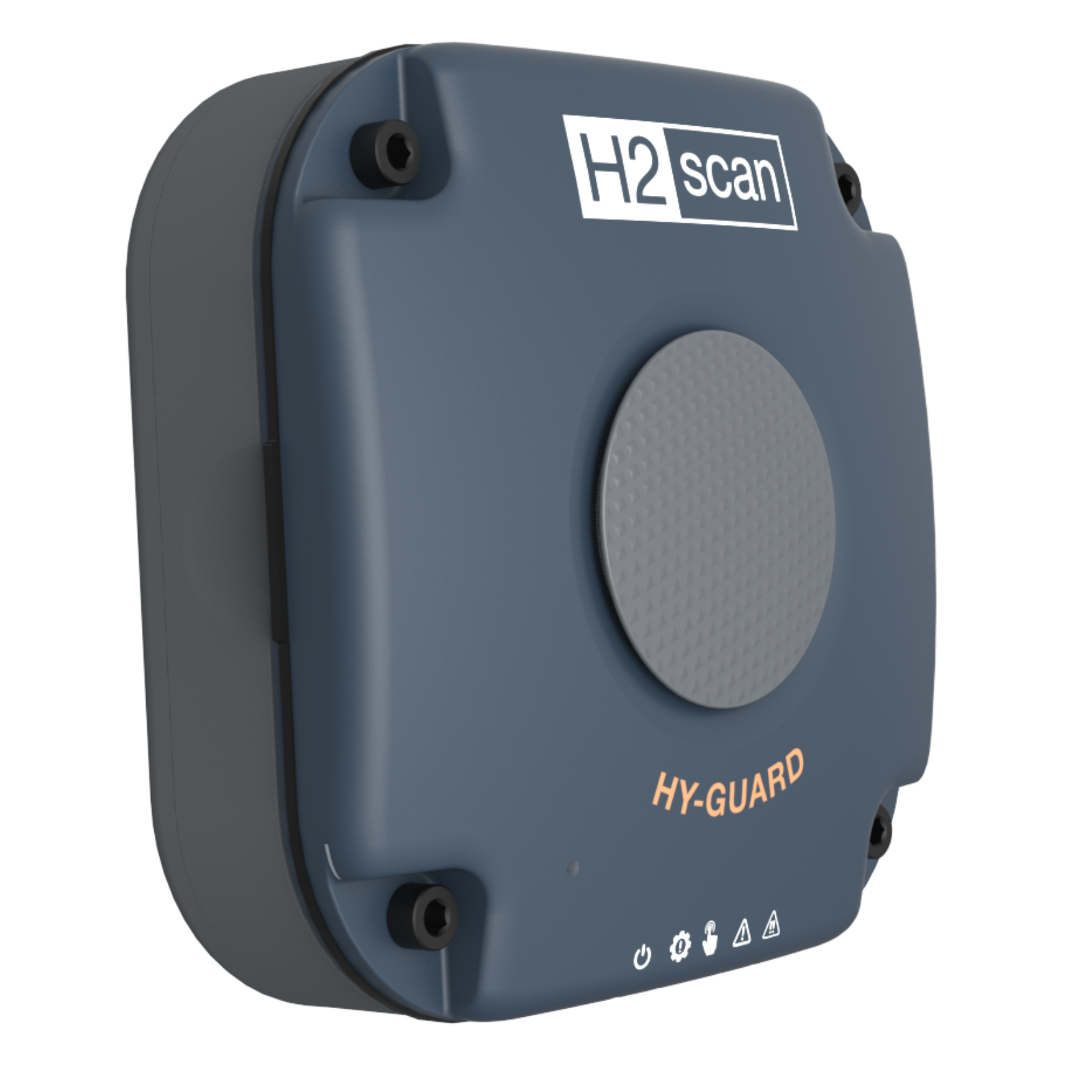
All-in-one area monitor with customizable communications for battery rooms and standby power. Maintenance-free, with no calibration or replacement parts over its service life.
View product
In modern data centers, hydrogen monitoring is a non-negotiable safety requirement for uninterrupted power supply (UPS) battery rooms. However, traditional Catalytic Bead Pellistor sensors create a paradox: the very equipment meant to ensure safety introduces significant physical risk to personnel.
Because these sensors drift over time, they typically require manual calibration every quarter or every six months. In many facilities, sensors are mounted at ceiling heights above battery cabinets or infrastructure, requiring ladders, lifts or elevated platforms for access.
This creates several potential points of concern:
Technicians must carry calibration gas bottles and regulators up the ladder, making it impossible to maintain a safe grip. OSHA regulation 29 CFR 1910.23 addresses ladder safety in general industry. Including maintaining balance and secure positioning while ascending or descending. Carrying tools or gas cylinders can increase the risk of instability depending on the task and setup.
Situations in which a technician holds equipment in both hands may limit their ability to maintain three-point contact. OSHA 1910.23(b)(13) also notes that employees should not carry loads that could cause a loss of balance. In practice, these conditions may increase exposure to safety risks and potential compliance concerns if not properly managed. These cumulative violations expose facilities to ‘Willful Violation’ penalties that, in 2026, can exceed $16,000 per instance.
Handling pressurized calibration cylinders at elevation introduces the possibility of dropped objects. A cylinder dropped from a height has the potential to damage nearby equipment or create additional hazards. OSHA 1910.28 addresses protection from falling objects, emphasizing the importance of minimizing such risks in elevated work environments.
For reference, even a small 5-lb cylinder dropped from a height can generate significant impact energy. Incidents involving falling objects may also carry regulatory and financial consequences depending on the situation and severity. Fines can reach $16,550 for a first offense.
Due to these challenges, particularly where specialized fall-protection training or equipment is limited, maintenance activities may be delayed or performed less frequently than intended. In some cases, this can impact sensor availability or performance, potentially leaving gaps in monitoring coverage.
When hydrogen detection is part of a broader Hazard Mitigation Plan (HMP), maintaining system functionality is critical for both safety and compliance. Prolonged outages or inoperative devices can introduce regulatory concerns and increase operational risk. In more serious situations, failure to address known “Willful negligence” hazards may be evaluated under OSHA’s General Duty Clause, with potential consequences depending on the circumstances and severity of the condition. Fines can be up to $161,323 per sensor.
| Authority | Violation Type | Consequence |
|---|---|---|
| OSHA | Willful Violation | Fines up to $161,323 (as of 2026 inflation) per sensor. |
| Fire Marshal (AHJ) | Permit or Code Non-Compliance | Revocation of Certificate of Occupancy; Shutdown of facility. |
| Civil Law | Gross Negligence | Uncapped punitive damages in the event of an injury or explosion. |
Table 1.1: Potential Regulatory and Liability Considerations
Looking to avoid OSHA fines and ensure workplace safety? Experts recommend a proactive safety culture, documented audits, employee training and hazard correction.
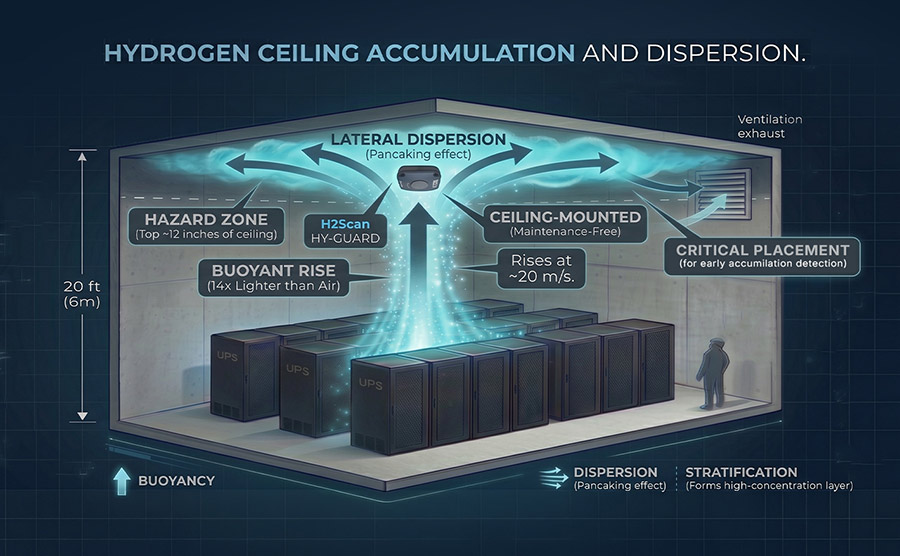
A common design assumption is to place sensors directly above battery cabinets to detect hydrogen at the source. This ignores the purpose of installing sensors to measure accumulation and the fluid dynamics of hydrogen. In practice, sensors are often better positioned in accessible ceiling areas, such as above aisles, where hydrogen is more likely to accumulate, while still remaining within the appropriate detection zones.
Hydrogen is significantly lighter (14x times) than air and rises rapidly once released. Upon reaching the ceiling, it tends to spread laterally, following airflow patterns and migrating toward ventilation or exhaust points. This behavior can lead to elevated concentration zones near the ceiling, where hydrogen levels may increase before being detected by sensors positioned lower in the space.
The International Fire Code (IFC) and NFPA 855 focus on detecting hydrogen accumulation within a space rather than identifying localized leaks. A detectable goal and commonly referenced threshold is 1% hydrogen concentration (25% of the lower flammable limit), which is used to initiate ventilation or activate a defined mitigation strategy. International standards such as IEC 62485-2 specify safe practices for managing hydrogen in standby battery applications to prevent accumulation.
Hydrogen typically accumulates near the highest points of a space, making ceiling-level areas, particularly along airflow paths or near exhaust vents, key locations for detection.
By shifting the focus from the “battery source” to “accumulation zones,” sensors can be positioned in locations that are effective for detection while being accessible. Placing sensors above aisle spaces rather than directly over equipment provides a practical balance between performance and serviceability.
The HY-GUARD uses solid-state hydrogen sensor technology with AccuSmart™ self-calibration, eliminating the need for manual calibration. This removes the reliance on “human-on-a-ladder” maintenance activities, helping to minimize associated safety risks and support improved compliance with ladder safety practices.
The HY-GUARD solves the OSHA compliance issue at the source.
No Calibration Sensors vs. HY-GUARD’s AccuSmart™ Auto-Calibrating Sensor
No-calibration sensors, often categorized as maintenance-free or disposable units, are typically factory-sealed with a fixed operating life. While they eliminate the need for routine span adjustments, they generally have limited ability to assess their own condition over time.
Because these sensors cannot internally verify whether the sensing element has been coated, poisoned or otherwise degraded, periodic functional checks, such as bump testing with an external gas source, are commonly required to confirm proper response in the event of an alarm condition.
H2scan’s Gen 5 and HY-GUARD technologies utilize a sophisticated solid-state architecture to deliver true self-calibration. Rather than relying on external air references or manual calibration, the system incorporates an internal physical reference that continuously validates measurement accuracy.
Every 12 hours, the hydrogen sensor performs active diagnostics to verify both gain and offset integrity. This autonomous process enables the device to maintain precision and stability for over a decade without user intervention.
The key advantage of this internal reference approach in self-calibration is the elimination of silent failures. Conventional “no-calibration” sensors can drift or fail undetected, requiring routine gas applications to confirm proper operation. In contrast, HY-GUARD is inherently self-aware, continuously monitoring its own health and issuing alerts if performance ever deviates from specification. This capability effectively removes the need for routine bump testing and significantly reduces maintenance requirements.
While many hydrogen monitors claim to be maintenance-free, only HY-GUARD actively verifies and maintains its accuracy throughout the life of the instrument.
| Feature | Catalytic (No‑Calibration) | HY-GUARD |
|---|---|---|
| Operating Principle | Fixed lifespan; no active adjustments | Real-time internal self-correction. |
| Verification Method | Requires routine manual bump testing | No gas-based testing required, automated self-verification every 12 hours |
| Failure Mode | Prone to silent failure with no diagnostics | Continuous self-monitoring with alerts |
| Maintenance Requirement | High Manual checks and calibration verification |
Zero Designed for 10+ years maintenance‑free operation |
Table 1.2: Hydrogen Sensor Reliability Comparison
Hydrogen monitoring is critical for data center safety, especially in UPS battery rooms. Proper hydrogen detection systems depend on placing sensors where gas accumulates near the ceiling. Traditional sensors require manual maintenance at dangerous heights, posing risks to personnel and leading to OSHA violations, fines and legal liabilities. These maintenance challenges sometimes lead to disabling sensors, increasing regulatory risk. The HY-GUARD system is a solid-state, maintenance-free solution that eliminates manual calibration and supports both safety and compliance. This approach reduces operational costs, removes staff hazards, and ensures reliable regulatory compliance, establishing hydrogen safety as a proactive standard.

About the Author
HY-GUARD®