
Hydrogen is among the most hazardous industrial gases due to its exceptionally low minimum ignition energy and wide flammability range. Industry standards for battery energy storage systems require limiting the hydrogen concentration to just 1% by volume—well below the 4% lower explosive limit at which ignition becomes likely. And hydrogen is colorless, odorless, and invisible, meaning dangerous accumulations can develop without any visible warning signs.
With the global hydrogen market projected to exceed $300 billion by 2030, growing at 12% annually, infrastructure is expanding rapidly across utilities, battery energy storage facilities, and industrial operations. As this growth accelerates, facility managers face a critical safety decision: portable or stationary detection? The answer isn’t which technology is “better”—it’s understanding how each addresses specific failure modes in comprehensive hydrogen safety programs.
Stationary vs Portable Hydrogen Detectors: Choosing the Right Strategy for Utilities, Refineries, Petrochemical Facilities and Energy Storage Facilities
Think of portable hydrogen detectors like a Geiger counter for hydrogen—diagnostic tools you carry where you need them that excel in scenarios where flexibility and mobility matter most.
Portable detectors are ideal for confined space monitoring. When technicians need to check hydrogen levels inside cabinets, boxes or controlled environments, a portable sensor offers the form-factor advantage. Unlike bulky fixed units with nozzles and mounting requirements, handheld devices feature a simple wand-and-tube design.
Leak detection represents another strong use case. When you need to check fittings, connections or pipe joints for hydrogen leaks, portable detectors let you probe specific areas without permanently mounting sensors.
Building inspectors and maintenance crews benefit from portable devices during routine safety rounds. Rather than installing sensors at every potential checkpoint, inspectors can carry one device across multiple locations and facilities. This approach works well when you need verification or spot checks rather than continuous coverage.
Process measurements in industrial settings favor portable units. When technicians need to measure hydrogen concentration in a specific stream, probe-based measurements provide quick readings without the engineering overhead of a permanent installation.
Here is a table of the different roles of stationary and portable hydrogen detectors in different industries.
| Industry | Use Cases | Role of Stationary Hydrogen Detectors |
Role of Portable Hydrogen Detectors |
|---|---|---|---|
| Utilities (Transformers, Substations and Switchgear Rooms) | Dissolved hydrogen in transformer oil; ambient hydrogen around transformers, switchgear and enclosed substations | Early fault detection and fire prevention depend on continuous hydrogen monitoring | Follow-up investigation, non-instrumented assets and field maintenance support |
| Refineries | Hydrogen-rich process streams, hydrotreaters, hydrocrackers, reformers and storage | Accurate hydrogen readings in hydrocarbon-rich environments reduce false alarms and missed leaks | Operator rounds, hot work safety, localized leak checks around piping and equipment |
| Petrochemical Plants | Feedstock conversion, off-gas handling, reactors and complex units | Complex gas mixtures and high consequences of failure favor continuous monitoring of key points | Spot checks, maintenance activities, support during shutdowns and turnarounds |
| Energy Storage & Battery Rooms | PS rooms, grid-scale storage, telecom battery rooms and data center backup systems | Hydrogen can accumulate quickly; fixed detectors tied to ventilation and alarms support code compliance and insurer expectations | Commissioning, troubleshooting and verification of fixed systems |
Stationary Hydrogen Detectors: The Continuous Guardian
Fixed hydrogen sensors provide 24/7 monitoring regardless of whether people are present, creating continuous safety coverage in high-risk areas.
Battery rooms and energy storage facilities demonstrate why stationary hydrogen detectors matter. Hydrogen can accumulate rapidly in these spaces, and missing an event can have severe consequences. Fixed sensors integrated with building management systems, ventilation controls and alarm infrastructure provide the continuous monitoring these applications demand.
The integration capabilities of stationary systems extend their value beyond simple detection. When hydrogen levels rise to 1%, fixed sensors can automatically activate ventilation fans. At higher concentrations, they can trigger deflagration venting systems and notify site personnel. This continuous monitoring becomes critical in unmanned facilities or during off-hours.
Data trending represents another advantage of continuous monitoring. Rather than snapshot readings from periodic checks, fixed sensors build historical data that supports predictive maintenance and root-cause analysis. Facility managers can identify developing issues before they become emergencies.
Key Limitations: Why One Doesn’t Replace the Other
The Portable Hydrogen Detector Gap
Portable hydrogen detectors create coverage gaps between measurement rounds. Hydrogen leaks can develop and dissipate between checks, leaving no evidence of the event.
Hydrogen’s rapid buoyancy creates practical challenges. In facilities with high ceilings, hydrogen concentrates well above where technicians can reach with handheld wands. Additionally, when technicians open doors to measure hydrogen in confined spaces, the gas often escapes before readings stabilize.
Maintenance overhead adds operational burden. Portable detectors require frequent calibration, bump testing and detailed recordkeeping. While fixed sensors can incorporate self-calibration technology, portable units demand manual validation testing every six months or more often.
The Stationary Hydrogen Detector Trade-offs
Fixed systems require a higher upfront investment in sensors, wiring, network integration and installation. Engineering design work determines optimal placement, coverage zones and integration points with existing building management or SCADA systems.
Coverage limitations mean stationary systems protect defined areas, not entire facilities. Other locations still require portable devices for ad hoc tasks.
When to Use Which: Quick Decision Checklist
Deploy Stationary Hydrogen Detectors when:
- Continuous monitoring is required by fire codes or insurance
- Hydrogen could accumulate in unmanned spaces or during off-hours
- Automated response (ventilation, alarms and shutdowns) is needed
- High-consequence equipment is present (transformers, batteries and critical processes)
- Historical data trending supports operational decisions
Utilize Portable Hydrogen Detectors when:
- Conducting periodic safety rounds or inspections
- Checking locations during maintenance activities
- Verifying fixed sensor performance or investigating alarms
- Measuring in confined spaces during entry procedures
- Supporting commissioning or troubleshooting work
Example: Building inspectors checking forklift charging areas can use portable detectors for periodic verification. But the same facility should install fixed sensors when charging multiple forklifts in a single area, which creates a persistent hydrogen accumulation risk.

Building Your Hydrogen Detection Strategy
- Step 1: Map hydrogen risk zones by facility type (battery storage, data center, refinery, petrochemical and warehouse with electric or hydrogen forklifts).
- Step 2: Decide where stationary hydrogen detection is mandatory vs. where portable-only coverage is acceptable.
- Step 3: Specify hydrogen-specific, long-life detectors for stationary monitoring.
- Step 4: Define procedures and training for portable device use.
- Step 5: Integrate data and alarms into existing safety and control systems.
| Detector Type | Pros | Cons |
|---|---|---|
| Stationary Hydrogen Detectors |
|
|
| Portable Hydrogen Detectors |
|
|
Why Hydrogen-Specific Detection Matters
Not all stationary hydrogen sensors are created equal. In refineries, petrochemical plants and hydrocarbon-rich environments, cross-sensitivity creates a critical vulnerability. Multi-gas detectors designed to detect multiple substances can trigger false alarms for methane, propane or even solvent fumes, which are present throughout industrial facilities. These nuisance alarms don’t just inconvenience operators; they erode confidence in the entire detection system.
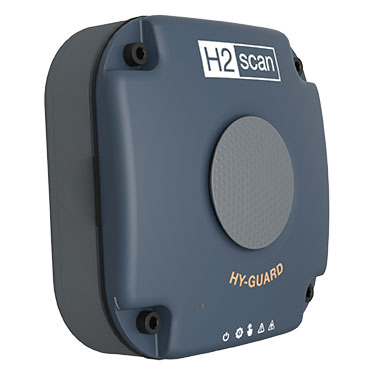
The HY-GUARD® hydrogen-specific monitoring system (as one example) from H2scan can eliminate this problem through selective detection technology that ignores hydrocarbons entirely. When an H2scan sensor alarms, facility managers know it’s hydrogen—not a Sharpie marker (true story), not cleaning solvents and not process gases. This specificity is particularly valuable in refineries where hydrogen process streams operate alongside countless hydrocarbon sources.
Beyond accuracy, sensor longevity directly affects the reliability of safety systems. Traditional catalytic bead sensors require replacement every 3-5 years and calibration every 3-6 months. During calibration intervals, detection coverage is interrupted.
H2scan’s solid-state sensors deliver around 10+ years of no-maintenance operation with drift-check technology that eliminates manual calibration. The sensors maintain accuracy without the maintenance burden and coverage gaps that plague legacy sensor technologies.
Seamless Integration for Critical Infrastructure
Stationary hydrogen detection delivers maximum value when integrated into existing safety infrastructure. H2scan solutions connect directly to:
- Building management systems for automated ventilation control
- SCADA and DCS platforms in utilities and industrial facilities
- Fire alarm panels and emergency shutdown systems
- Data historians for compliance documentation and trending analysis
This integration transforms detection from a standalone alarm into an active safety layer. When hydrogen reaches 1% concentration in a battery room, H2scan sensors have the ability to connect to BMS systems to automatically activate exhaust fans. At higher thresholds, the system triggers deflagration venting, notifies personnel and logs the event—all without human intervention.
The safety triggers benefit operations with high-value assets that often operate in unmanned or minimally staffed locations where manual intervention isn’t feasible. Integration with existing Supervisory Control systems means hydrogen detection becomes part of the facility’s operational intelligence, not just a disconnected safety device.
The Complete Detection Strategy
H2scan’s hydrogen-specific, stationary, continuous-monitoring technology provides the foundation for guarding critical infrastructure. Portable detectors complement this coverage by enabling technicians to verify fixed sensor performance, investigate alarms, conduct confined-space entry checks, and perform maintenance in areas where permanent installation isn’t justified.
Together, these technologies create defense in depth: continuous monitoring where consequences are highest, portable verification where human activity and flexibility matter most.
Ready to build your hydrogen detection strategy? Contact H2scan to discuss how hydrogen-specific monitoring solutions can strengthen your facility’s safety and reliability program. Our team will help you determine the optimal combination of fixed and portable detection for your specific applications—from battery energy storage systems to industrial hydrogen processing to utility infrastructure.

About the Author