
What data center engineers should look for in a hydrogen monitor for UPS battery rooms
Standby power is a basic requirement for every data center, and the batteries behind the UPS are changing. Lithium-ion is increasingly specified for UPS because it takes less floor space and weight and offers up to 10 times the cycle life of lead-acid, while aqueous batteries, such as lead-acid, remains widely installed. Many facilities now operate both, sometimes in the same building. Each chemistry releases hydrogen differently, and the hydrogen monitoring system has to match. This post helps data center engineers and specifiers know what to look for in a hydrogen gas monitoring system for UPS battery rooms.
This information is timely. As companies build more data centers to support AI, standby battery capacity grows with them. Utility-scale battery storage is growing even faster, but it is a different application, engineered and managed by different teams. We cover it in a companion post on hydrogen monitoring for lithium-ion BESS containers.
Chemistry sets the monitoring requirement
Lead-acid batteries, both VRLA and VLA, release hydrogen during charging and under abnormal conditions. The gas accumulates slowly and predictably, so lead-acid monitoring is designed to detect hydrogen building up over time. The time a sensor needs to detect hydrogen and send a signal can be several minutes with no negative impact on safety.
Lithium-ion batteries behave differently. They do not release significant gas during normal operation. They vent only under abnormal conditions such as thermal runaway, when mechanical stress, a manufacturing defect, electrical abuse or outside heat causes the battery’s protective SEI (solid electrolyte interphase) layer to break down. Cells start shorting internally and heat builds. Hydrogen then appears, along with carbon monoxide, carbon dioxide and other gases. The hydrogen can burn and even explode under the right conditions.
Battery management systems (BMSs) monitor voltage, current and temperature, but not hydrogen gas. That is why safety standards address flammable gas directly.
In rooms with both chemistries, the monitoring approach has to account for both. H2scan’s HY-SIGHT display can show readings and manage standard HY-GUARD monitors for lead-acid batteries and HY-GUARD RS for lithium-ion batteries monitors together.
What the standards require
NFPA 855 addresses stationary energy storage systems, and data center UPS projects with lithium-ion and lead-acid UPS batteries commonly design to it, subject to the local authority having jurisdiction. Hydrogen becomes flammable at a concentration of 4% by volume, known as its lower flammability limit (LFL). Both chemistries require hydrogen to be kept at safe levels. The NFPA 855 requires action well before gas gets close to the point of the lower flammability limit, which is a 4:1 ratio of gas to air to allow for action to be taken in accordance with the site’s Hazardous Mitigation Plan (HMP). The 2026 edition requires lithium battery systems to have explosion control and prevention designed to NFPA 69, the standard on explosion prevention systems.
Where gas detection is used to activate a combustible concentration reduction system, such as exhaust ventilation, based on an NFPA 69 deflagration study, NFPA 855 calls for a listed continuous gas detection system that activates it at no more than 10% of the LFL, which is 0.4% of hydrogen. The ventilation must then stay on so flammable gas does not exceed 25% of the LFL on average, or 1% of hydrogen. The ventilation system and its components are treated as a critical safety system, and both systems annunciate at a supervising station.
Internationally, IEC 62485-2 covers stationary lead-acid and nickel-cadmium batteries, including hydrogen ventilation, and IEC 62485-5 covers stationary lithium-ion batteries. Insurers add their own requirements. FM Global Data Sheet 5-32 covers data centers and related facilities.
Where UPS batteries live
Data center UPS batteries are typically installed in dedicated rooms with the required fire-rated walls and safety systems. Operators often build these rooms as pods connected to the building, which compartmentalizes the batteries from the rest of the facility. Some operators instead use prefabricated power modules that combine the UPS, batteries and switchgear in one weatherproof enclosure, with vendors offering modules from several hundred kVA to over a megavolt-ampere. Some data centers in occupied office buildings use lead-acid batteries for their UPS systems, while co-location facilities sometimes house lithium-ion batteries in dedicated areas. In these indoor spaces, sensor maintenance is the main practical consideration.
Unlike a BESS container, these rooms and pods can be occupied by people. Technicians go in to inspect, test and maintain equipment, so the condition of the room matters before anyone opens the door. Displays should be placed outside the room or pod to show its condition, including whether it is safe to enter. A hydrogen monitoring system that reports status outside the area gives technicians that information before they step inside.
Brownfield sites add another layer. When a UPS battery room is in a pre-existing facility, it may need to be retrofitted to meet current safety requirements, including hydrogen sensing. Existing rooms were not always designed with those requirements in mind, and space for new equipment can be limited. Hydrogen sensing matters even more where people can occupy the room or where the batteries sit inside the building, because the consequences of a gas event reach the people and the structure around them. Retrofit projects benefit from monitors that install easily and need little maintenance afterward.
Ceiling-height sensors and the maintenance burden
Gas monitoring systems must be located near the ceiling, because hydrogen is lighter than air. The sensors may be installed 15 feet or higher above the floor, tight against the ceiling, requiring technicians to climb ladders for servicing. To calibrate a conventional sensor, the worker must carry a heavy bottle of calibration gas, which creates a fall and drop risk as well as an OSHA concern about maintaining three points of contact. The alternative is a lift, which can be hard to maneuver in a room crowded with racks. In either case, maintenance consumes considerable labor hours.
Too often, sensor maintenance gets put off or missed, leading to a safety gap with the Hazardous Mitigation Plan (HMP) that can lead to potentially serious consequences. In lithium-ion battery storage rooms, that gap matters more because the hazard develops faster. A hydrogen monitor for a battery room should have self-checking electronics and report its health status.
Response speed
Once a lithium-ion cell begins venting, conditions in a room can change quickly, and every second of detection delay shortens the time available to ventilate and respond. FM Global reports that in its testing the gap between off-gassing and thermal runaway ranged from about five to 20 minutes. A monitor that responds in seconds uses that window instead of spending it. Lead-acid rooms can tolerate a monitor response of several minutes based on the slow rise of hydrogen over time. For lithium-ion, response speed belongs near the top of the specification, because fast, reliable hydrogen detection is a practical part of lithium battery fire prevention.
Calibration and testing
Whether lithium-ion batteries sit in a data center UPS room or a co-location hall, the question is whether the operator can reliably maintain the safety system and do so cost effectively. Any gas monitor that requires bump testing or calibration eventually forces someone to choose between skipping maintenance and accepting risk. A self-calibrating sensor avoids that choice. With HY-GUARD, there is no calibration gas to carry up a ladder and no calibration visit to schedule, because the sensor continuously self-calibrates.
Be careful with monitors advertised as “no calibration required.” Often that means calibration drift has been slowed, not that accuracy is being checked, so accuracy can degrade quietly until an incident. Other designs limit drift by requiring periodic sensor replacement, which is itself a maintenance event and a cost. Include those costs in the total cost of ownership.
Selecting the right hydrogen gas monitor for UPS rooms
Across every UPS deployment, lithium-ion battery safety and lithium-ion battery monitoring come down to three things:
- Hydrogen sensor response speed that matches how fast lithium-ion batteries fail.
- Hydrogen sensor accuracy that doesn’t degrade unnoticed.
- Hydrogen gas monitoring that minimizes maintenance costs and the need to put workers at risk.
These capabilities determine total cost of ownership and even whether the safety system will operate when it matters most.
These requirements guided the development of H2scan’s HY-GUARD® RS gas monitoring system for lithium-ion batteries.
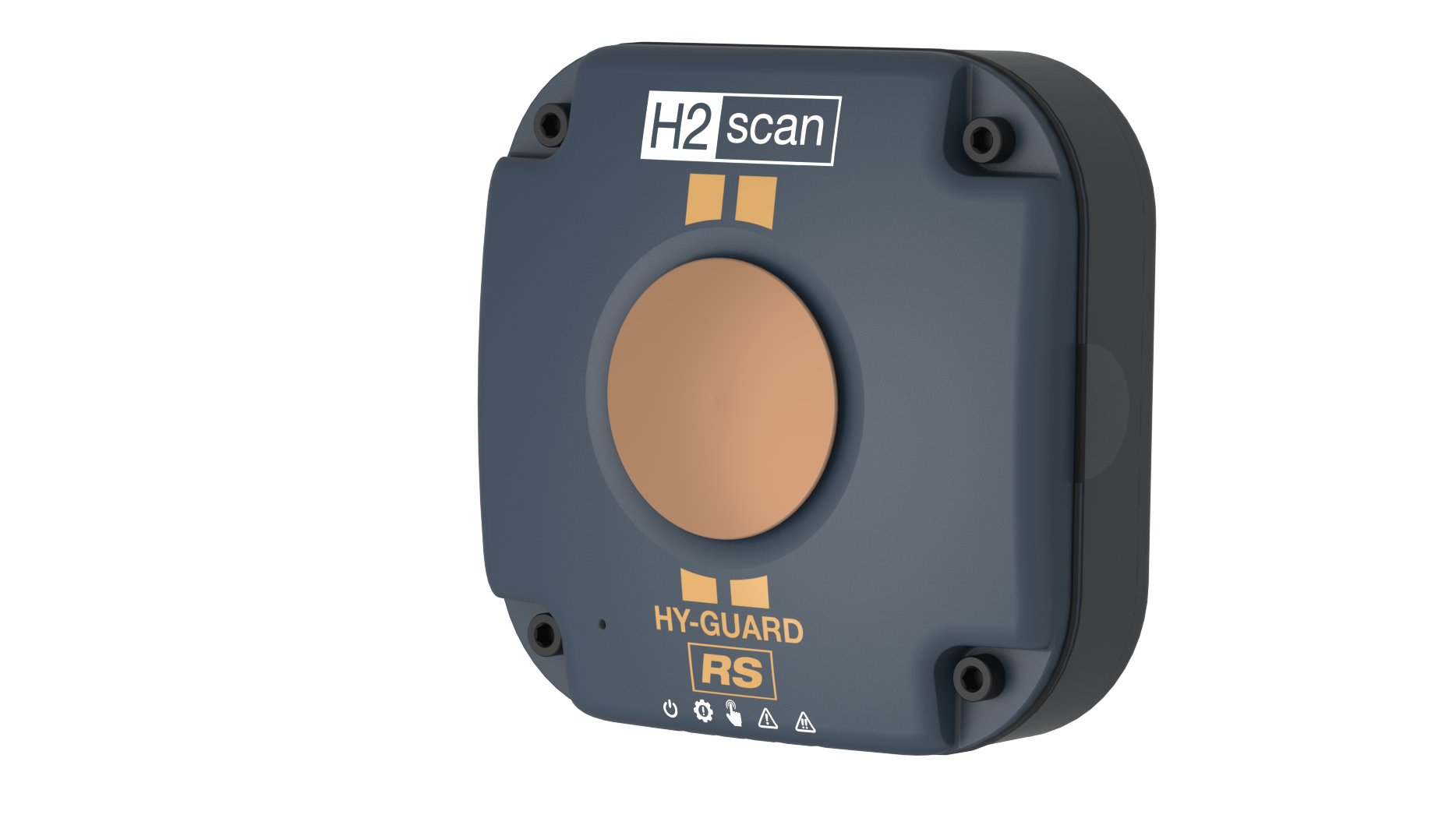
HY-GUARD RS hydrogen gas monitoring system:
- Built for lithium-ion speed: The monitor responds in under 10 seconds.
- Self-calibrates continuously: No calibration bottles, no ladders, no lifts and no climbing to ceiling-mounted sensors. Patented solid-state sensor technology continuously self-calibrates.
- Self-checking technology: The monitor checks the health of its own electronics, avoiding the risk of assuming a monitor is working just because its green light is on.
- Maintenance free: 10+ year service life with no routine field recalibration.
- Scales through a single Modbus daisy chain: Daisy chain sensors to one monitoring system to reduce the electronics required and lower system cost. The HY-GUARD platform lets specifiers connect additional units without repeating full electronics at every sensor point.
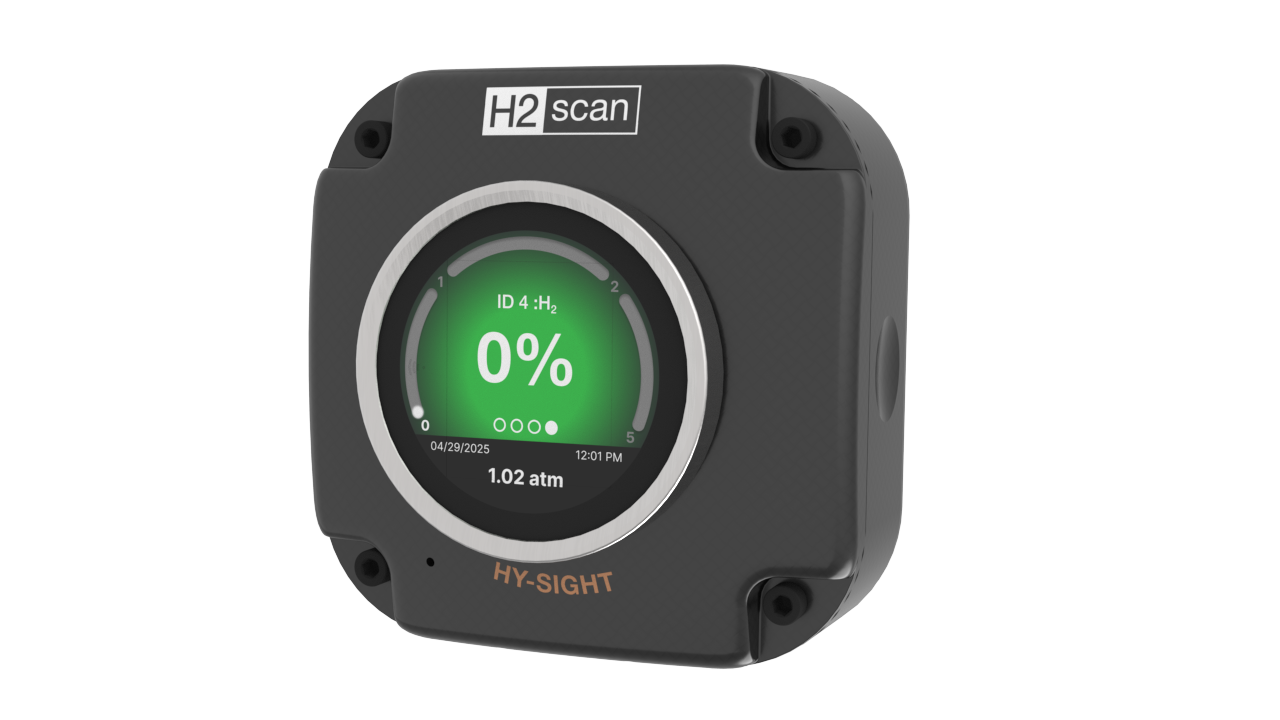
An optional controller with a screen display, the HY-SIGHT™ controller, powers and manages up to four HY-GUARD RS or standard HY-GUARD monitors. The HY-SIGHT controller enables at-a-glance inspection and control of connected monitors. It provides Modbus RTU, 4-20 mA and direct safety relay outputs. It also provides history and data logging for analysis. Mounted outside a battery room or pod, a display like this shows the condition of every monitor in the room before anyone enters.
Talk to an expert about your hydrogen monitoring situation and discover strategies for minimizing maintenance costs while improving safety.
Contact us to talk through the technology that fits your facility.

About the Author