
A false alarm shut down an entire semiconductor facility for a day. Equipment went offline, the building was evacuated, and the recovery took weeks, at a cost that likely ran into millions of dollars. The cause was not a hydrogen leak. The cause was a hydrogen detection system that did not distinguish between hydrogen and other gases sharing the same process environment. A false alarm that caused all-too-real financial consequences.
For process safety engineers, that scenario illustrates the real cost of a bad detection system selection. The unit’s upfront price might be visible on a purchase order. But the cost of a cross-sensitive hydrogen sensor doesn’t show up until further downstream, long after the purchase was made, when adding in unplanned downtime, emergency response and production loss.
This is the main problem stemming from sensor cross-sensitivity, and it is more common than the industry likes to admit. Most hydrogen detectors deployed in process safety applications today rely on thermal conductivity detector (TCD) technology, a platform with a well-documented vulnerability to false positives in environments where multiple gases are part of normal process chemistry. Choosing the wrong sensor in those environments isn’t a minor inconvenience, but an operational liability. New technology in hydrogen detection systems can solve this problem to help alleviate the financial risk associated with false alarms.

The Cross-Sensitivity Problem that Calls for Hydrogen Gas Detection
In standalone field-deployed area monitors, a TCD sensor works by passing gases across a single heated filament. Whatever contacts that filament alters its resistance, and that change is reported as a reading. The fundamental problem is that many gases alter filament resistance, not just hydrogen. Carbon monoxide, carbon dioxide, hydrogen sulfide and VOCs can all produce a reading on a TCD sensor regardless of whether hydrogen is present.
TCD technology performs differently when integrated into a gas chromatograph, where a two-filament configuration allows the system to subtract background gas effects. But standalone TCD sensors lack this capability, and they are far more common in field-deployed safety monitoring. In process environments where CO and H2S are part of normal operations, a standalone TCD is not a reliable tool for hydrogen detection.
The consequences of false positives in these environments are well documented. Beyond the immediate disruption of an unplanned evacuation, repeated false alarms create a subtler and equally serious problem: erosion of trust in the safety system itself. Personnel might begin to ignore alarms or disregard the risk. This could cause a delayed response to a real hydrogen leak with cascading safety consequences.
TCD sensors can also require frequent calibration, sometimes daily. Every hour that a sensor produces unreliable readings represents both a safety exposure and an operational liability.

Why Sensor Selectivity Matters More Than Upfront Cost
These TCD-based sensors gained popularity because of their low cost. However, the real cost calculation is more complicated than the initial purchase price, particularly in environments where cross-sensitivity to background gases is routine.
- When evaluating any hydrogen leak detection equipment, engineers should be asking vendors for:
- Data on cross-sensitivity performance across relevant background gases, including CO, CO2, H2S and VOCs
- Calibration frequency requirements and total annual maintenance burden
- Sensor survivability in the presence of toxic background gases such as hydrogen sulfide
- Self-calibration capability and validated uptime between service intervals, and
- Carrier gas dependencies, particularly relevant for GC-based systems, where helium supply chain disruptions can leave monitoring systems offline
A gas detection system that requires daily calibration and generates false alarms in the presence of routine process gases is not a low-cost solution. It is a recurring operational liability dressed up as capital savings.
How H2scan’s Hydrogen Gas Detection Technology Addresses the Problem
Some hydrogen detection systems use a solid-state sensor that operates through an electrochemical mechanism rather than thermal conductivity. The alloy catalytically dissociates hydrogen’s diatomic molecule into individual atoms, which absorb into the metal’s crystalline lattice and generate a measurable voltage change. Only hydrogen atoms are small enough to enter that lattice. Other gases cannot.
This is the industry definition of “hydrogen immunity”: a sensor architecture that is inherently non-responsive to background gases, not one that attempts to filter them out after the fact. The result is a system that detects when hydrogen gas is present and does not report hydrogen gas when it is not. In environments where CO, H2S and other interferents are part of normal process chemistry, that distinction is operationally critical. Importantly, H2scan hydrogen detection also features self-calibration, unlike TCD-based detectors. The self-calibration feature extends service intervals and reduces maintenance, especially where it’s hard to access to the detector.
Hydrogen Detection Systems Provided by H2scan
HY-OPTIMA® 2700 Series: For Petrochemical Applications
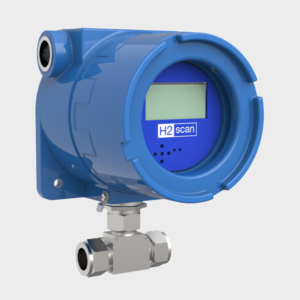
The HY-OPTIMA® 2700 Series Explosion Proof In-line Hydrogen Process Analyzer is engineered for process streams where hydrogen coexists with carbon monoxide and hydrogen sulfide, the background gases that most commonly trigger false positives in competing technologies. Sensors in this series are pre-conditioned for these gases, delivering reliable measurement without cross-sensitivity-driven alarms in petrochemical refining and similar environments.
HY-ALERTA® 5320: For Semiconductor Manufacturing and Other Industries
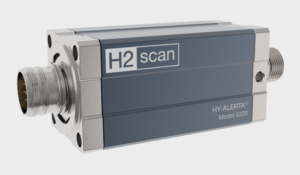
The HY-ALERTA® 5320 Intrinsically Safe Hydrogen Area Monitor is purpose-built for processing applications including the hazardous chemical environments of semiconductor fabs and sub-fabs, where flammable and corrosive gases are routed through gas cabinets and process tooling alongside hydrogen at every stage of fabrication. Combining inherent cross-gas selectivity with maintenance-free operation and a 10-year sensor warranty, it gives process safety engineers a sensor they can rely on in demanding environments without the false-alarm risk associated with TCD technology.
Contact H2scan to discuss which sensor platform is right for your facility and process environment. Visit h2scan.com to learn more.
What are hydrogen detection systems?
Hydrogen detection systems are safety and monitoring systems designed to detect hydrogen gas in air or in a process stream. In practice, a system usually includes a hydrogen sensor, electronics that interpret the signal and outputs that can trigger alarms, ventilation, shutdowns or building controls. They are used in places such as battery rooms, hydrogen processing areas, refueling areas, and petrochemical facilities because hydrogen is colorless, odorless, highly flammable and rises quickly when released.
How does a hydrogen gas detector work?
A hydrogen gas detector works by continuously sampling the surrounding atmosphere or process gas, sending that sample to a hydrogen-sensitive element, and converting the sensor response into a concentration reading such as ppm or percent hydrogen. The detector then compares that reading to preset thresholds and can activate local alarms, ventilation, remote monitoring, or shutdown actions when levels rise. Where the detector is installed matters because hydrogen is lighter than air and can accumulate near ceilings or high points in enclosed spaces.
What is the difference between a hydrogen sensor and a hydrogen detection system?
A hydrogen sensor is the sensing element that responds to hydrogen and produces a measurable signal. A hydrogen detection system is the complete safety setup built around that sensor, typically including the sensor, electronics or controller, display, alarms, relays, ventilation or shutdown outputs, and integration with plant or building systems. In other words, the sensor is the core measuring component; the detection system is what turns that measurement into a usable safety action.

About the Author